
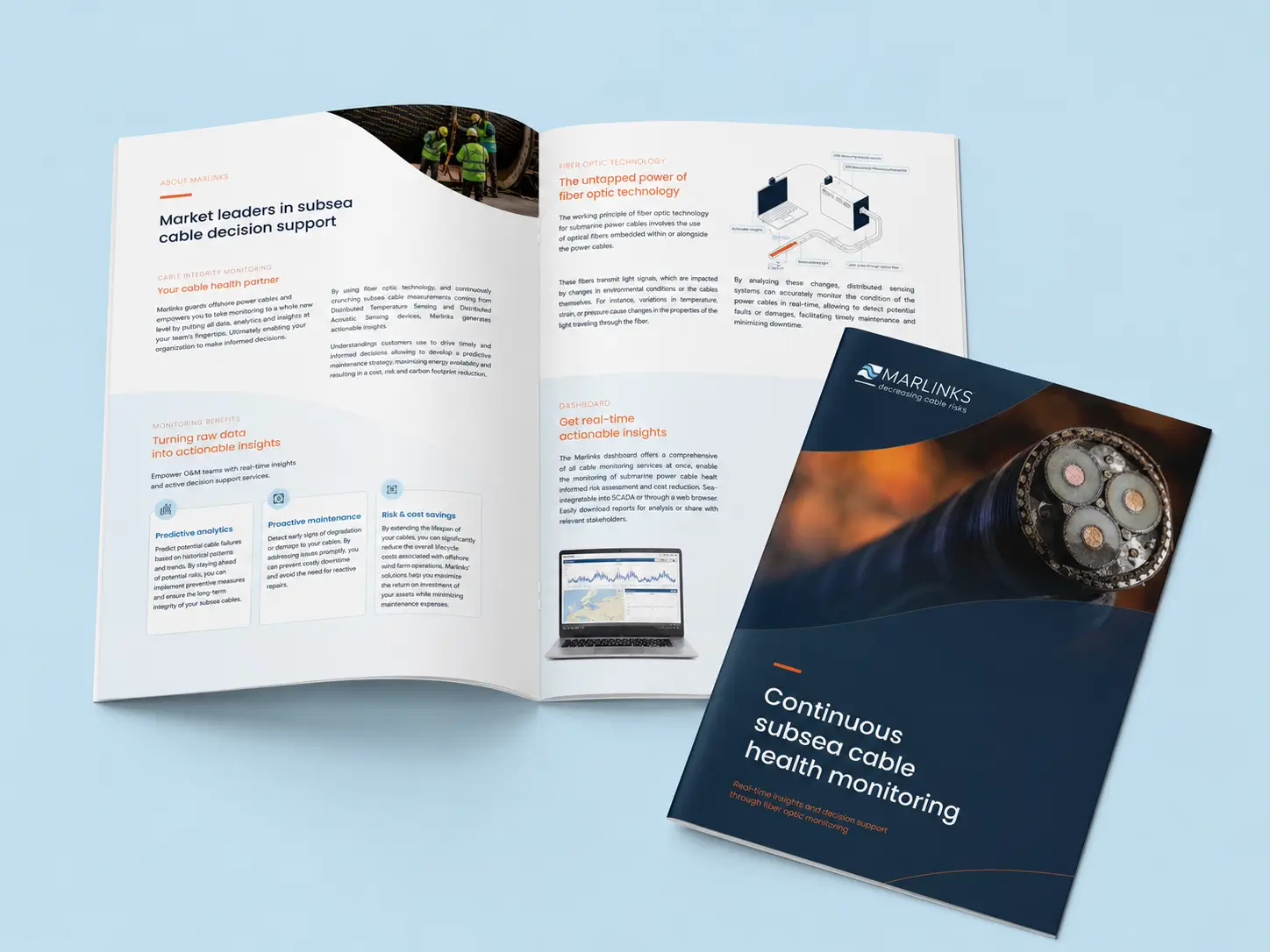
Continuous subsea cable health monitoring

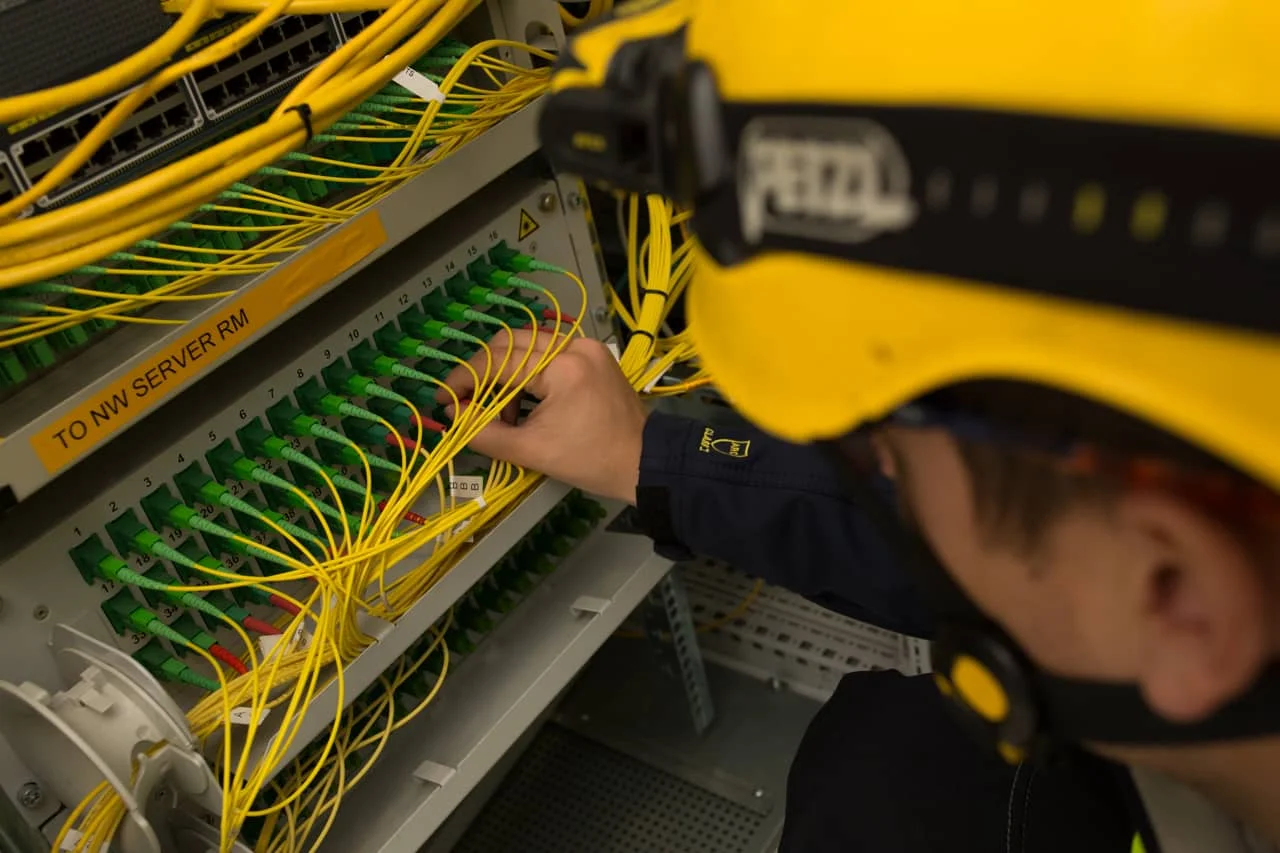
Collaborating with our clients, we first determine the method to retrieve necessary data from their premises. This could involve sharing data via files, databases, or collecting it through – for example – a web interface.
In the next step, we assess the availability of historical data. With historical data, our model becomes operational within a maximum of three months. If no historical data exists, we will start collecting data with Marlinks. After six months of data collection, the model becomes operational.
Lastly, we verify the reliability of available data, often we need to recalibrate the hardware (DTS or DAS) to ensure accurate data.
Depending on the hardware device type, such as DAS or DTS, the daily data storage varies. Factors like cable length, signal frequency, and spatial resolution influence the data volume. For example, a 6km cable with a 2000Hz signal results in approximately 190GB of daily data with a Distributed Acoustic Sensing (DAS) device. Given the substantial data storage involved with a DAS, timely deletion or selective storage based on patterns, like a scraping pattern of a Cable Protection System (CPS), is crucial. Real-time data processing is also essential for DAS devices.
With a Distributed Temperature Sensing (DTS) device, we do not need to know in real-time if – for example – the cable is exposed. The data is therefore less huge than with a DAS measurement. Currently, we import data every five minutes.
Monitoring options are based on customer preferences:
We usually keep subsea cable data for five years, because the data is less relevant after more than five years. For the data of the temperature in the cable, it is useful to keep this for one or two years in order to be able to trace back the influences of the seasons. The period can of course always be discussed with the customer.
Ownership of data security and backups lies with the designated server administrator. When Marlinks manages the server, rest assured, we prioritize and take charge of all aspects related to data security and backups. Our commitment is to provide robust protection and reliable maintenance for your valuable data assets.
All data received, whether from the customer or the DTS or DAS device, falls under the category of raw data an unstructured dump lacking a predefined format. In the initial phase of information gathering, we extract and identify essential information crucial for developing our monitoring software.
Moving into the insights phase, we search for links or structures within the data. For DAS, this may reveal events like Cable Protection System (CPS) abrasion or impacts already cataloged in our library. Once identified in our processed data, these events allow us to draw conclusions, such as recognizing a risky event that warrants further investigation by the operator.
The dashboard allows the customer to look at all insights individually and is very user-friendly. The dashboard summarizes everything into simple graphs that are easy to interpret, for example, you can see where and when something is happening along your subsea cable. We have included some additional add ons, an example is that you can set certain parameters to warn you if your cable is not buried deep enough. Marlinks also provides a periodic report with actionable insights.
Would you like to learn more about how we collect, manage and turn data into actionable insights with Marlinks? Get in touch with sales@marlinks.com.