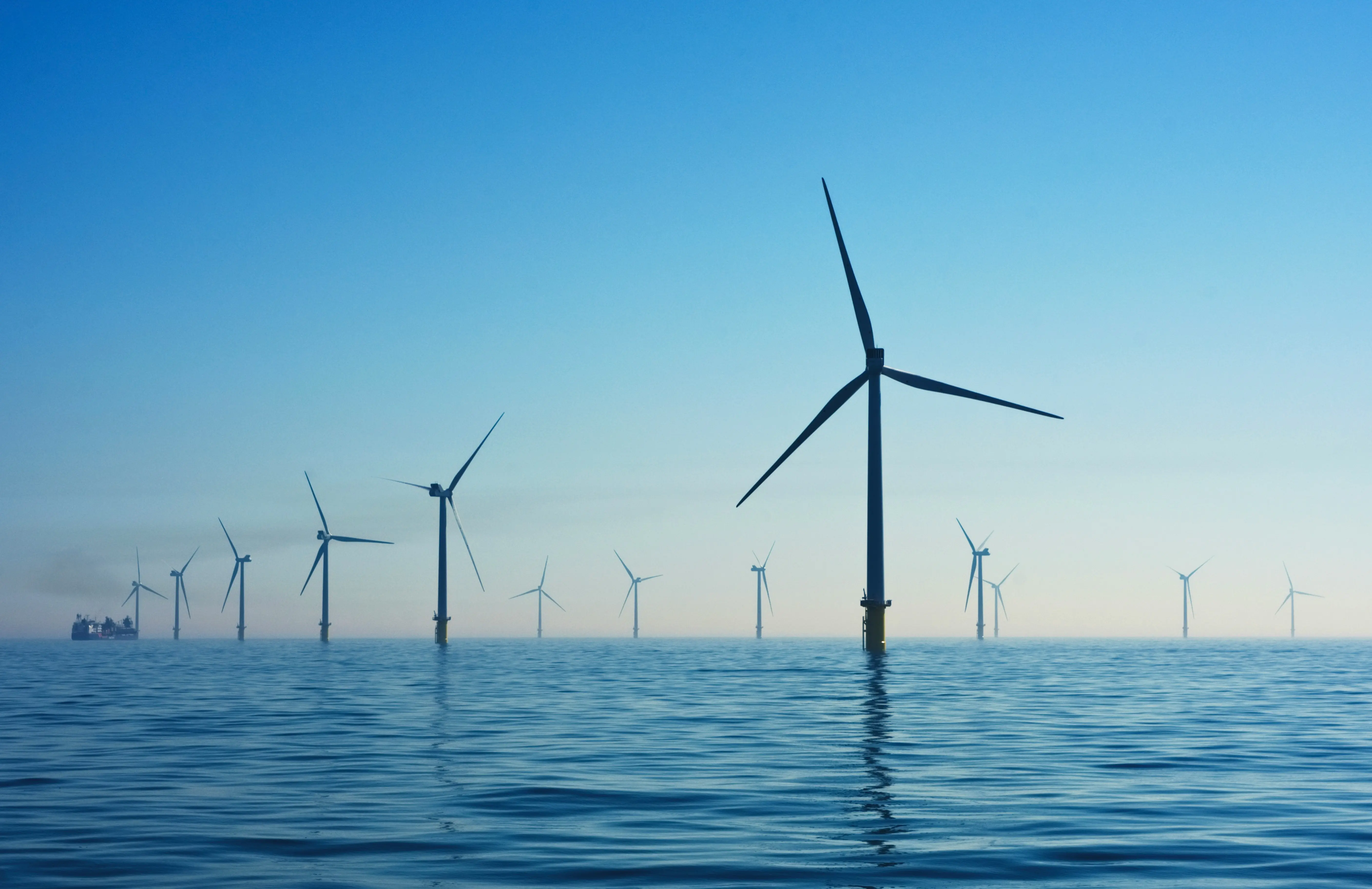
No two offshore wind projects are designed exactly alike. As developers adopt new grid configurations to meet changing operational needs, monitoring solutions must be flexible enough to support both today’s layouts and tomorrow’s innovations. By 2050, Europe’s seas are expected to have up to 450 GW of production from offshore wind farms alone. Reliably delivering such quantities of energy is not necessarily trivial, so wind farm operators are exploring alternative methods of power distribution [1], going further than the traditional centralized power delivery route via an offshore substation.
The shift towards meshed offshore grids
One such approach is to use a shared transmission network, or a so-called meshed grid, to distribute the production from all wind farms in a given area, in a similar fashion to what is already performed in onshore transmission systems. Progress towards this is already happening in Belgium, the Netherlands, and Denmark, with the advent of energy islands [2], which serve as distribution hubs for offshore wind energy.
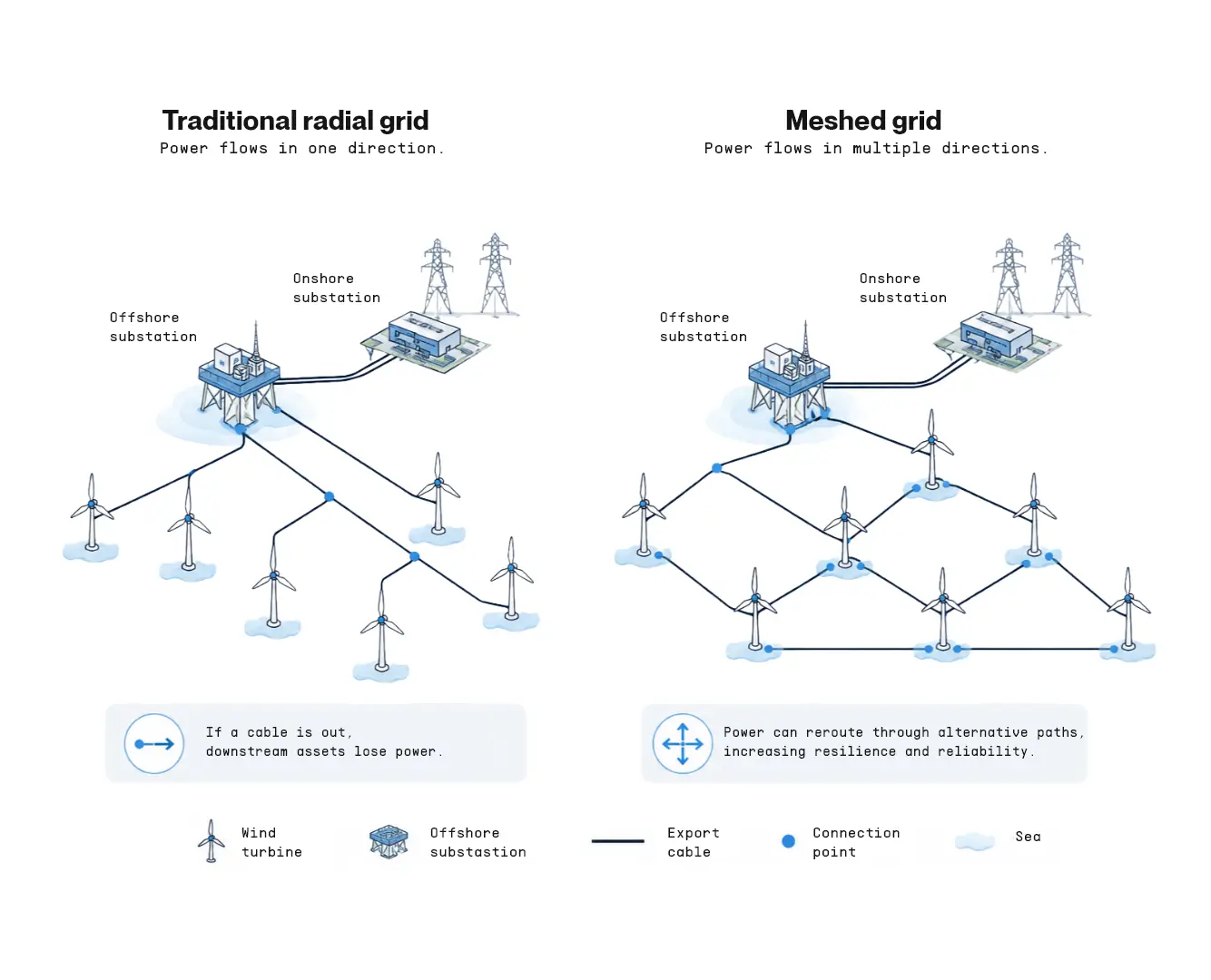
Besides the growing interest and investment into a meshed grid, there is also an increasing number of wind farms with more complex layouts than the traditional radial format, such as branched or ring layouts, where there is more than one linear path for power flow, allowing for a more resilient farm [3].
Monitoring requirements for complex offshore grid layouts
At Fluves, in order to compute our Real Time Thermal Rating (RTTR) and Depth of Burial (DoB) modules, we require power production data from all turbines, so that we can accurately model the heat transfer from cable to environment.
Flexible cable monitoring with Marlinks
Whether supporting today’s radial layout or tomorrow’s meshed offshore grids, our product, Marlinks, provides the flexibility to adapt to changing network designs, and we are able to provide RTTR and DoB modules to any prospective clients. We are able to adapt to existing wind farms which have traditional radial power distribution systems; we can configure for the future of offshore wind with alternative grid configurations, and the long-awaited meshed offshore grid.
FAQs
What is a meshed offshore grid?
A meshed offshore grid is an interconnected electricity transmission network that allows power generated by offshore wind farms to flow through multiple routes, rather than relying exclusively on individual radial connections.
Why do complex offshore wind farm layouts require flexible cable monitoring?
Branched, ring and meshed configurations can introduce multiple power flow paths. Monitoring systems must account for these configurations to accurately assess cable operating conditions and support safe, reliable power transmission.
Can Marlinks monitor cables in meshed offshore grids?
Yes. Marlinks is designed to accommodate different offshore grid configurations, including radial, branched, ring and meshed layouts. Its Real-Time Thermal Rating (RTTR) and Depth of Burial (DoB) capabilities can be configured using the relevant power production data and network information.
References
[3] *Singh, D., et. al., (2025). Offshore Horizons: HVDC Wind Farms-Exploring Techno-Economic Dimensions. IEEE Access, 13, 94910–94943. https://doi.org/10.1109/access.2025.3567624*